Introduction
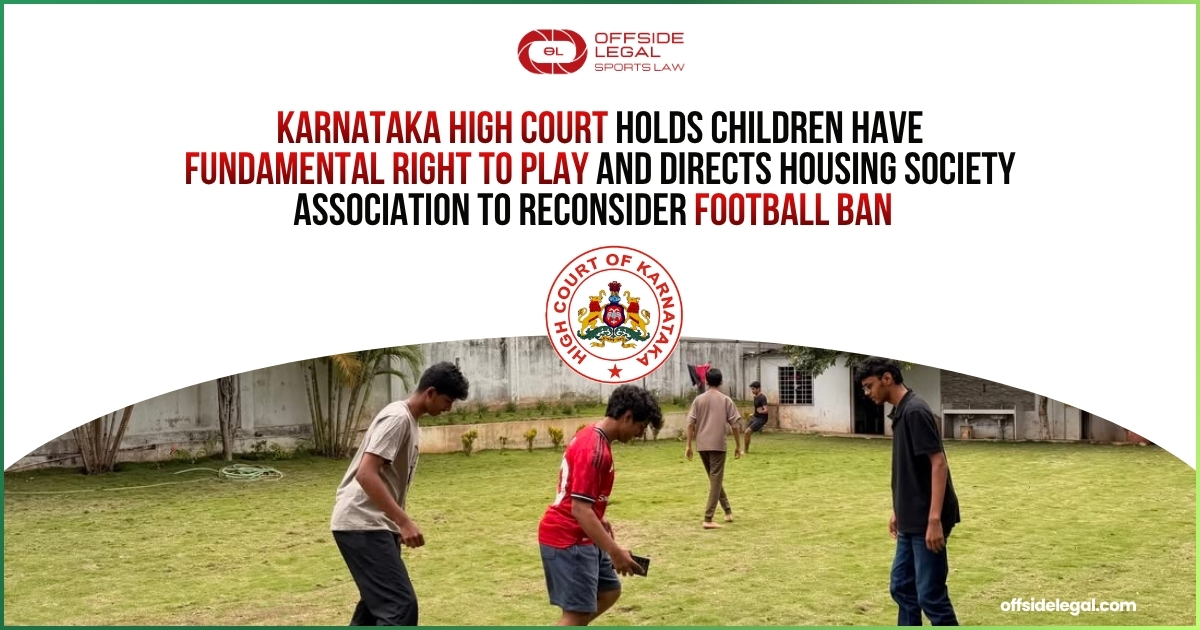
The Karnataka High Court has held that children have a fundamental right to play, directing a housing society association in Bengaluru to reconsider its decision prohibiting children from playing football and other physical games in the apartment playground. The ruling came in Regular First Appeal No.1826 of 2021, decided on 16 June 2026 by Justice Hanchate Sanjeevkumar, arising out of a dispute between apartment owners and the Esteem Gardenia Apartment Owners Association over both a stairway obstruction and a ban on children playing games in the common playground.
Background of the Case
The appeal was filed by Mrs. Sangeetha Agrawal and Mr. Hemant Agrawal, owners of a flat in the Esteem Gardenia Apartment at Sahakara Nagar, Bengaluru, against the judgment and decree dated 27 September 2021 passed by the X Additional City Civil and Sessions Judge, Bangalore, in O.S.No.9969/2015. The trial court had dismissed the plaintiffs’ suit seeking mandatory injunction and damages against the defendant association.
The plaintiffs had been residing in the Primrose block of the apartment as tenants from September 2008 to May 2010, after which they purchased Flat No.101 on the first floor under a registered sale deed dated 31 May 2010. Their case was that the association had placed flower pots in the common stairways of the Primrose block, in violation of the apartment’s own bye-laws, which prohibit placing furniture, packages, vehicles, or any objects in common lobbies, vestibules, stairways, and elevators. The plaintiffs stated that watering these pots made the stairways wet and slippery, and that on 29 August 2012, plaintiff No.1 slipped while walking from the terrace to the third floor, suffering a serious fracture injury that required surgeries on 30 August 2012 and 13 October 2012, with further surgery required for removal of implants.
The plaintiffs further stated that despite informing the association about the incident, the pots were removed only temporarily before being placed back on the stairways, and that the association allegedly tried to pressure the plaintiffs into withdrawing their complaint by raising it in a General Body meeting. In its written statement, the defendant association contended that the pots were placed based on a majority decision of the association rather than by any individual owner, and that the pots were removed only after the suit was filed.
Also Read: Sony Pictures Secures Commonwealth Games 2026 Broadcast Rights in India
The Football Ban and the Fundamental Right to Play
Separately, the plaintiffs also challenged a circular notice issued by the association prohibiting children from playing football and other physical games in the apartment’s playground. The trial court had upheld this prohibition, framing an issue on whether the circular notice banning football in the playground was null and void and not binding on the plaintiffs, and ultimately ruling in favour of the association on this point while dismissing the suit as a whole for failure to prove the stairway obstruction claim.
On appeal, the plaintiffs argued that the playground was meant for common use by all children residing in the apartment, and that restricting children from playing games in this area was illegal and arbitrary, restricting their mental and physical development and violating child rights. The defendant association had contended that the decision to stop football in the play area was taken based on complaints from residents, and that only certain games considered suitable for the play area were allowed to be played.
The High Court noted that the written statement filed by the association did not clearly specify which games were permitted and which were prohibited in the play area, describing this averment as vague and lacking clarification. On this basis, the Court held that the defendant/association could not prohibit children from playing games in the play area on such a vague and unclarified basis. The judgment states in clear terms that playing games by children is a fundamental right to play, and that prohibiting children from playing takes away their overall health.
Also watch: Age Fraud in Sports | Adv. Shivam Singh
The Court’s Direction on the Fundamental Right to Play
Having recognised the fundamental right to play, the Court directed the defendant/association to reconsider its earlier decision, with the consent of the majority of the residents, and to determine which games would be allowed and which would not be allowed in the play area. Importantly, the Court clarified that by stopping one or two specific games, children should not be deprived of playing games in the play area altogether. The association was directed to specify the permitted games after taking the confidence of its members, and to take this decision within a period of three months from the date of the judgment by convening a general body meeting.
On the separate issue concerning the stairways, the Court held that the stairways and corridors of the apartment are common areas meant for the use and occupation of all flat owners, a fact the defendant association itself did not dispute. The Court found that keeping pots on the stairways, which required regular watering, caused the floor to become wet and slippery, obstructing free movement and infringing the civil rights of the plaintiffs. The Court held that the plaintiffs had proved this fact through medical documents, including exhibits P-27 to P-38, showing that plaintiff No.1 suffered fracture injuries from falling on the stairways.
The Karnataka High Court allowed the Regular First Appeal, setting aside the judgment and decree dated 27 September 2021 passed by the trial court. The suit was decreed by mandatory injunction directing the association to remove the pots from the stairways and other common areas, along with a perpetual injunction restraining the association from keeping any pots or materials on the stairways and corridors in future. On the playground issue, the Court granted a mandatory injunction directing the association to decide, by majority vote at a general body meeting within three months, which games children would be permitted and not permitted to play — reaffirming throughout that the fundamental right to play could not be taken away from children on vague or unclarified grounds.
Read the Judgment here: Karnataka High Court Upholds Children’s Fundamental Right to Play Sangeetha Agrawal & Anr. vs. M/S Esteem Gardenia Apartment Owners Association, RFA No. 1826 of 2021 (Judgment dated 16.06.2026)