Introduction
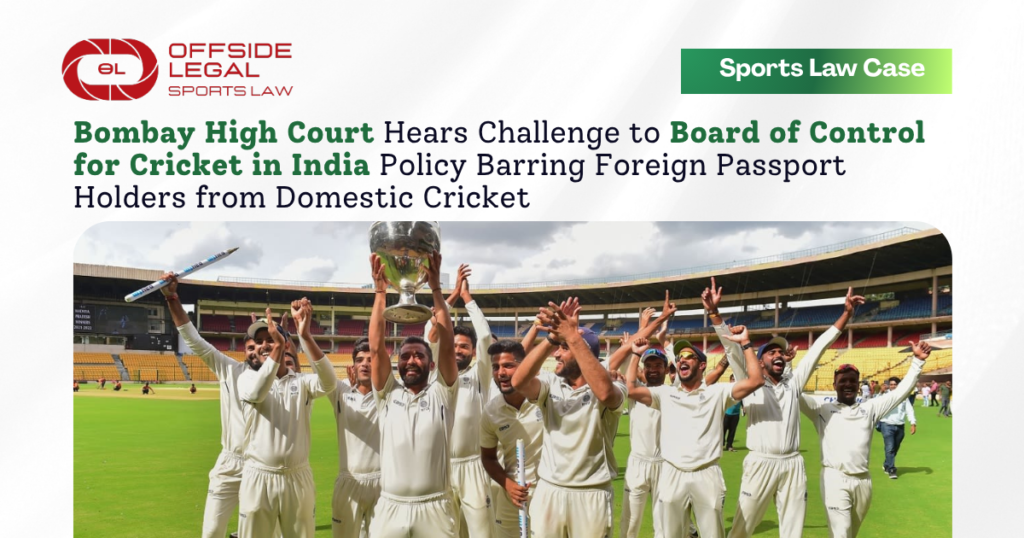
The BCCI passport policy barring foreign passport holders from domestic cricket is once again under judicial scrutiny, as the Bombay High Court continues to hear a petition filed by twelve young cricketers holding Overseas Citizen of India (OCI) cards. The petitioners argue that the Board of Control for Cricket in India’s 2023 eligibility rule has arbitrarily shut them out of the very system that nurtured their cricketing careers, raising fresh questions about how sports governing bodies balance national interest against individual opportunity.
Background: The 2023 Resolution
The dispute traces back to a resolution passed by the BCCI on 18 December 2023, which made an Indian passport mandatory for any player wishing to participate in its domestic tournaments, including marquee competitions like the Ranji Trophy. Before this resolution, OCI cardholders – many of Indian origin, born or raised abroad but trained within India’s domestic cricket ecosystem, were permitted to compete alongside Indian nationals. The sudden policy shift left several young cricketers, some of whom had spent years training in India, without a pathway to continue playing at the domestic level.
Twelve such cricketers, led by petitioner Kavin Kartik, approached the Bombay High Court in Kavin Kartik & Ors. v. The Board of Control for Cricket in India, Writ Petition (L) No. 22903 of 2024, along with Interim Application (L) No. 28986 of 2025, challenging the BCCI passport policy as arbitrary and violative of Articles 14 and 21 of the Constitution. Their counsel argued that the right to play sport forms part of personality development under Article 21, and that several petitioners already had Indian citizenship applications pending at the time the rule took effect.
Also Read: FMSCI Gets Provisional NSF Status Under National Sports Governance Act 2025
The Court’s Order on Interim Relief
By its order dated 26 September 2025, a Division Bench of Justices M.S. Sonak and Advait M. Sethna declined to grant the petitioners any interim mandatory injunction against the BCCI passport policy. Appearing for the petitioners, Advocate Kunal Cheema relied on a cluster of precedents, including Sorab Singh Gill v. Union of India (where the Punjab and Haryana High Court had granted relief to OCI cardholders even at the national-representation level) and Anushka Rengunthwar v. Union of India (where the Supreme Court faulted the retrospective application of a rule barring NRIs/OCIs from NEET admissions) — to argue that the resolution was manifestly arbitrary. For the BCCI, Senior Advocate Dr. Birendra Saraf, along with Advocate Ankit Lohia, countered that only Indian nationals are eligible for the national team, that domestic tournaments exist as the feeder pool for that selection, and that this was a considered decision of the Board.
Applying the settled test from Dorab Cawasji Warden v. Coomi Sorab Warden, which requires a petitioner seeking an interim mandatory injunction to show a probability of success higher than an ordinary prima facie case, the Bench held that no case of manifest arbitrariness had been made out against the BCCI passport policy. The Court noted that while the BCCI is not “State” under Article 12, it may still be amenable to writ jurisdiction when discharging public functions; even proceeding on that assumption, the Court found the BCCI’s stated rationale, protecting the selection pool for the national team – was not manifestly arbitrary.
It also observed that allowing OCI cardholders into domestic tournaments could come at the cost of an Indian citizen player losing a place in the pipeline. The Bench accordingly dismissed IA (L) No. 28986 of 2025 and posted the main petition for admission on 17 October 2025, while recording liberty for the petitioners to make a representation to the BCCI for prospective relief, and directing the BCCI to decide any such representation expeditiously “because ultimately, they are dealing with the hopes and aspirations of young children.”
Also watch: Competition Law in Sports ft. Prof. Lovely Dasgupta
The Matter Returns to Court: Latest Update
Following admission, the petition was renumbered as Writ Petition No. 2307 of 2026, and came up for hearing on 17 July 2026 before a bench comprising Acting Chief Justice Ravindra V. Ghuge and Justice Gautam A. Ankhad. By this stage, the BCCI’s side had expanded, with Dr. Birendra Saraf, Senior Advocate, appearing along with Advocates Ankit Lohia, Ranjit Shetty, Tejas Gokhale, Avina Karnad and Pranav Shetty, while Kunal Cheema and Datta Mane continued to represent the petitioners.
The Court’s order records that the matter was “heard for some time,” and rather than proceeding further that day, both sides agreed to tender brief, recordable written notes of submissions, complete with case law, index and pagination, ahead of the next date. The petition challenging the BCCI passport policy has now been listed for final hearing at the admission stage on 13 August 2026 at 3:00 p.m. This procedural step signals that the Bombay High Court is moving toward a more substantive examination of the BCCI passport policy, beyond the narrower question of interim relief that was decided in September 2025.
Also watch: What is Sports Law In India | Mr. Subhrajit Chanda
What This Means for Indian Sports Governance
The ongoing litigation around the BCCI passport policy highlights a recurring tension in Indian sports law: the need for governing bodies to maintain clear, citizenship-based eligibility criteria for national representation, weighed against the legitimate expectations of young athletes who have built their careers within India’s domestic system. It also raises broader questions relevant to other national sports federations operating under the National Sports Governance framework; particularly around transitional protections for athletes affected by sudden rule changes, and the extent to which private sporting bodies performing public functions can be held to constitutional standards of fairness.
For families and young athletes navigating dual citizenship or OCI status, this case is a reminder that eligibility rules in Indian sport can shift with little advance notice, and that legal recourse against a body like the BCCI is neither straightforward nor guaranteed to succeed at the interim stage. Whether the courts ultimately compel a review of the underlying resolution, or whether the BCCI passport policy is left to stand as a matter of board autonomy, the outcome will shape how India’s cricketing pipeline treats players with foreign citizenship going forward.
Conclusion
As the Bombay High Court continues to weigh arguments on both sides, the case remains a significant test of how far constitutional principles of equality and fairness extend into the governance of India’s most powerful sports body. Offside Legal will continue to track developments in this matter, including the outcome of the next hearing and any formal decision on the players’ pending representations.
Also Read: Judo Federation of India Gets Conditional Nod After 4-Year Battle