Introduction
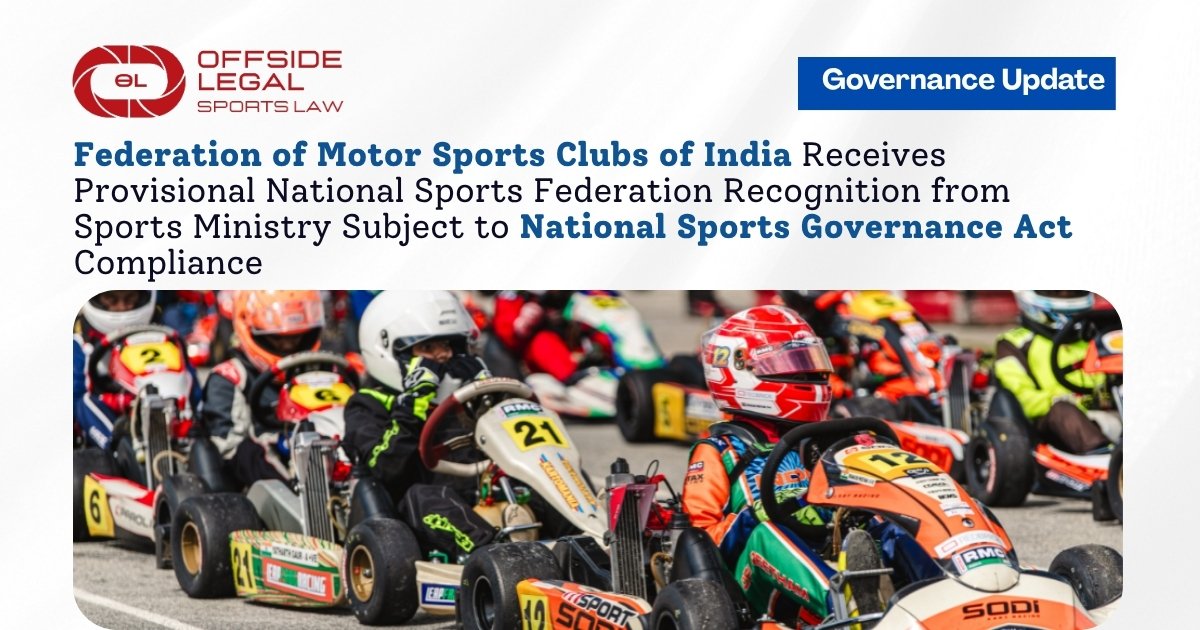
The National Sports Governance Act has claimed its first major stakeholder in Indian motorsport, with the Federation of Motor Sports Clubs of India (FMSCI) securing provisional recognition as a National Sports Federation (NSF) from the Ministry of Youth Affairs and Sports. The order, dated July 23, 2026, marks a significant governance milestone for a sport that has long operated on the margins of India’s formal sporting ecosystem, and it arrives at a moment when the country is actively courting the return of Formula 1.
For a firm that tracks sports governance closely, this development is worth unpacking in some detail, both for what it grants FMSCI and, more importantly, for what it demands of the federation going forward.
What the Recognition Actually Says
FMSCI, headquartered in Chennai and headed by Arindam Ghosh, applied for NSF status on June 11, 2026. Roughly six weeks later, the Ministry granted provisional recognition, stating that the request “has been considered” and that recognition takes effect “from the date of issue” of the order. This is not a blanket or unconditional recognition. The Ministry has expressly directed FMSCI to amend its constitution and Memorandum of Association to bring it in line with the provisions of the National Sports Governance Act, 2025, within stipulated timelines.
This conditionality is the operative part of the order. Provisional status under the Act functions as a probationary arrangement: the federation gets the benefits of NSF recognition now, but retains that status only by demonstrably reforming its internal governance architecture to match statutory requirements. The Ministry has also reserved the right to revoke recognition if FMSCI fails to comply with the guidelines framed under the Act, which places continuing legal pressure on the federation’s leadership to move quickly on constitutional amendments.
Also read: Sports Law Bootcamp 2026: Registrations Open
Why the National Sports Governance Act Matters Here
To appreciate the significance of this order, it helps to recall what the National Sports Governance Act actually does. Passed by the Lok Sabha on August 11, 2025, cleared by the Rajya Sabha the following day, and assented to by the President on August 18, 2025, the Act establishes a statutory framework for the recognition, governance, and oversight of national sports bodies in India. It was designed to replace the earlier ad-hoc arrangements under the National Sports Development Code of India, 2011, with a more legally robust structure, one that aligns Indian sports administration with the Olympic Charter, the Paralympic Charter, and international governance norms, while also creating formal mechanisms for dispute resolution, ethics codes, safe sports policies, and election oversight.
FMSCI’s case is an early test of how this framework will operate in practice. The federation is not simply being handed recognition; it is being brought within the compliance perimeter of a new statute that did not exist just a year ago. Any federation seeking or holding NSF status will now need constitutional and procedural alignment with the Act’s provisions, covering matters such as governance structure, athlete welfare, ethical conduct, and dispute resolution, or risk having recognition withdrawn.
The Practical Benefits and Their Limits
Recognition under the National Sports Governance Act is not merely symbolic. As an NSF, FMSCI becomes eligible for financial grants from the Ministry, a meaningful shift for a sport that has historically relied heavily on private sponsorship and club-level funding. The Ministry has also relaxed some norms relating to the minimum affiliation required for state units, easing one of the practical hurdles federations often face in demonstrating nationwide representation.
The order further signals that the government intends to give FMSCI “a major role… for promotion and development of the sport of motor sports in India,” which is a notable statement of institutional confidence, particularly given the renewed momentum around India’s motorsport ambitions. That momentum is closely tied to the Adani Group’s exploration of reviving the Formula 1 Indian Grand Prix at the Buddh International Circuit, a venue that hosted the race from 2011 to 2013 before it was dropped from the calendar amid disputes over whether the event should be taxed as sport or as entertainment.
Even so, the benefits of NSF status remain tethered to compliance. This is a structural feature of the National Sports Governance Act rather than an incidental condition attached to FMSCI’s order, since the Act’s entire design rests on continuing oversight rather than one-time recognition.
Also read: National Anti-Doping (Amendment) Act, 2025: India Overhauls Its Anti-Doping Regime
The Governance Lens
From a governance and regulatory standpoint, FMSCI’s provisional recognition is instructive on several counts. It confirms that the Ministry is prepared to use the National Sports Governance Act as an active compliance tool rather than a dormant statute, that recognition is now explicitly conditional on constitutional reform rather than administrative convenience, and that federations across disciplines should expect similar scrutiny as they seek or renew NSF status.
For sports federations, associations, and their counsel, this is a reminder that governance documents, including constitutions, MoAs, election bye-laws, and dispute resolution clauses, are no longer background paperwork. Under the National Sports Governance Act, they are the primary basis on which recognition, funding, and institutional legitimacy will be assessed. FMSCI’s next steps in amending its own framework will likely serve as a template that other federations watch closely as they navigate the same statute.
Also watch: Freedom of Speech in Sports | Mr. Tarun