Introduction
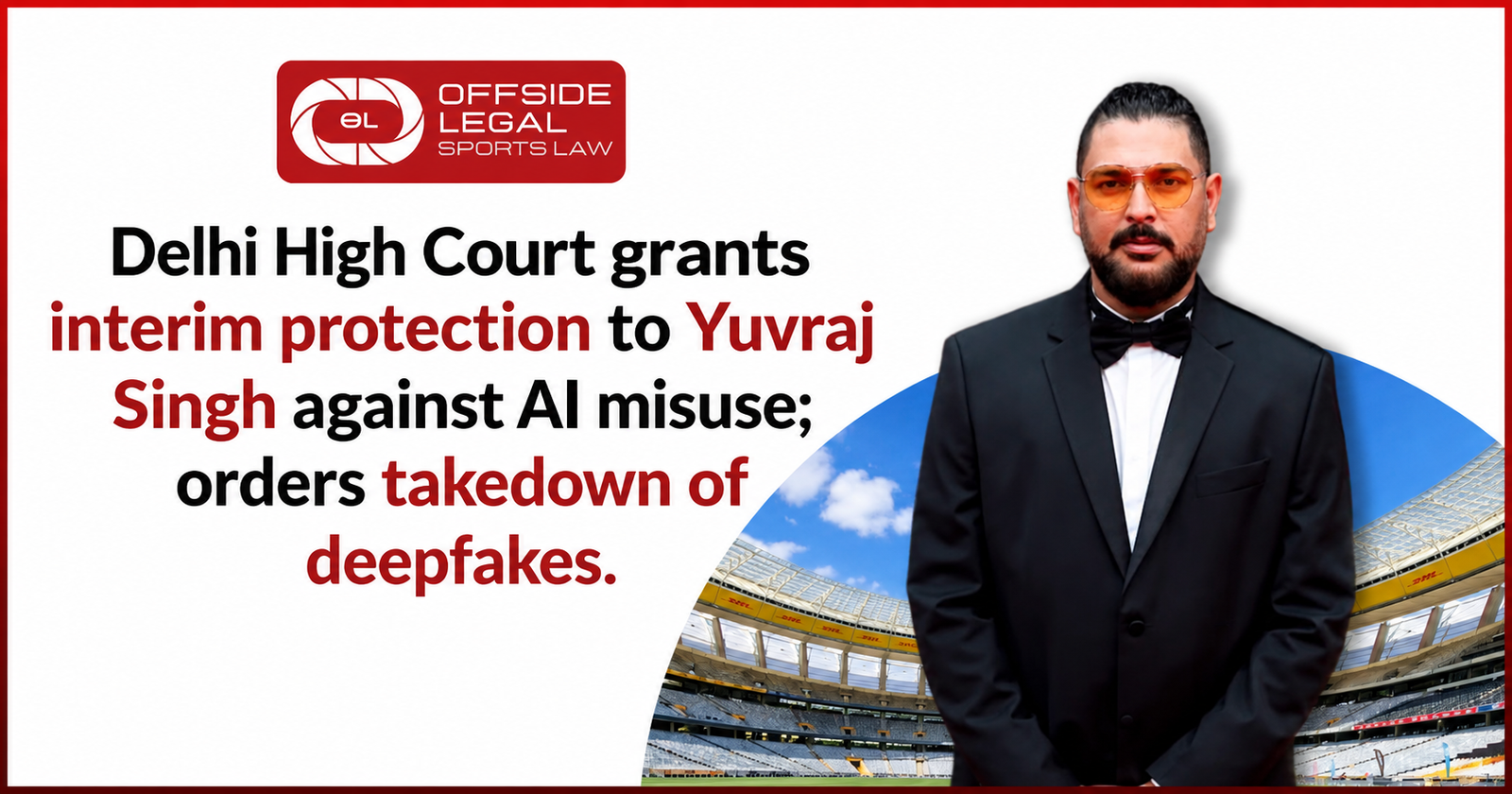
In a significant reaffirmation of celebrity Yuvraj Singh personality rights, the Delhi High Court has granted an ex parte ad interim injunction restraining eighteen defendants from misusing the former cricketer’s name, image, voice, and likeness through AI-generated content, deepfakes, and unauthorized merchandise. The order, passed by Justice Jyoti Singh on 29 July 2026 in CS(COMM) 796/2026, is one of the latest in a growing line of Delhi High Court rulings protecting the identity of well-known personalities from unchecked exploitation by artificial intelligence tools.
Background of the Case
Yuvraj Singh, the “Player of the Tournament” from India’s 2011 World Cup triumph and widely known as the “Sixer King,” approached the Delhi High Court after discovering a wave of AI-generated posts, videos, and unauthorized merchandise trading on his fame without consent. The plaint detailed a troubling pattern: fabricated images placing him at religious sites in insensitive ways, deepfake videos depicting him behaving aggressively or violently toward fellow cricketers, a Reddit post falsely attributing views on women to him, and multiple e-commerce sellers manufacturing T-shirts, posters, and stickers bearing his name and image without authorization.
The defendants ranged from anonymous social media accounts on Facebook, Instagram, and Reddit to e-commerce platforms and sellers, along with intermediaries such as Meta Platforms, Amazon Seller Services, and Flipkart Internet, who were made parties for the purpose of takedown compliance. This breadth of defendants illustrates how the violation of Yuvraj Singh personality rights extended across content platforms and commercial marketplaces simultaneously, rather than being confined to a single bad actor.
Also Read: Fundamental Right to Play: Karnataka HC’s Ruling for Children
Court’s Reasoning: Personality Rights and Commercial Value
The order recognized Yuvraj Singh’s decorated career, his 1,900-plus Test runs, 8,701 ODI runs, and his iconic six sixes in an over against England, along with his post-retirement social media following exceeding 21 million on Instagram alone, as establishing substantial commercial value in his persona. The Court noted that his personality attributes, including his name, voice, image, and mannerisms, function as source identifiers in the minds of the public and therefore merit legal protection from unauthorized exploitation.
Justice Singh relied on a consistent line of Delhi High Court precedent protecting personality rights of celebrities, including the recent Sunil Gavaskar ruling against Cricket Tak, the Anil Kapoor decision against Simply Life India, and the Jaikishan Kakubhai Saraf order against Peppy Store. These cases collectively establish that unauthorized commercial use of a person’s distinctive attributes constitutes both an infringement of rights and a dilution of individual identity, entitling the affected person to injunctive relief. The Court also cited the Supreme Court’s foundational privacy judgment in R. Rajagopal v. State of Tamil Nadu, which disapproved of using a celebrity’s name or likeness without consent, whether for advertising or non-advertising purposes.
Significantly, the order addressed the specific threat posed by generative AI tools. The injunction is notable for explicitly restraining the use of “Artificial Intelligence, Generative Artificial Intelligence, Machine Learning, Deepfakes, AI Chatbots, Face Morphing/Face-Swapping” and similar technologies to exploit the plaintiff’s persona — language that reflects how Indian courts are adapting personality rights jurisprudence to keep pace with rapidly evolving AI misuse. This aspect of the ruling on Yuvraj Singh personality rights makes it a useful reference point for future disputes involving athletes, actors, and public figures targeted by synthetic media.
Also Watch: Freedom of Speech in Sports | Mr. Tarun
Key Directions Passed by the Court
Having found a prima facie case, with the balance of convenience favouring the plaintiff and a likelihood of irreparable harm absent interim relief, the Court passed the following directions until the next hearing:
- Defendants No. 1 to 12, including unidentified John Doe parties, are restrained from using, reproducing, publishing, or disseminating Yuvraj Singh’s name, image, voice, or likeness for any commercial or personal gain through AI, deepfake technology, or face-swapping.
- Meta Platforms was directed to take down the infringing URLs listed in the order’s annexure within 36 hours.
- Amazon Seller Services and Flipkart Internet were similarly directed to remove listings for unauthorized merchandise within 36 hours.
- Turtle Wings and SMEEPS, two e-commerce sellers, were directed to take down specific infringing product listings within 24 hours.
- The plaintiff was directed to comply with Order XXXIX Rule 3 CPC (formal notice requirements for interim injunctions) within two weeks.
The Court also granted the plaintiff liberty to approach intermediaries or seek further legal recourse for any future infringing content discovered, keeping the door open for continued enforcement of his rights as new violations surface.
Also watch: Competition Law in Sports ft. Prof. Lovely Dasgupta
Why This Order Matters
This case adds to a growing body of Indian jurisprudence extending personality rights protection into the age of generative AI. As deepfake technology becomes increasingly accessible, the risk to athletes and public figures — whose reputations, endorsements, and public image carry real commercial and personal stakes — grows correspondingly. The Yuvraj Singh personality rights case demonstrates that Indian courts are willing to move quickly, granting ex parte relief and directing swift takedowns across multiple platforms and intermediaries in a single order, rather than requiring separate proceedings against each infringing account or seller.
For sports law practitioners, this order is also a useful illustration of how personality rights claims are increasingly intersecting with intermediary liability frameworks, e-commerce regulation, and platform takedown obligations — areas that are becoming central to how athletes protect their brand and identity in a digital-first economy.
At Offside Legal, we will continue tracking how the Yuvraj Singh personality rights order develops as the matter proceeds to its next hearing, and what it signals for the broader protection of athletes against AI-driven misuse of their identity.
Case: Yuvraj Singh v. Ashok Kumar & Ors., CS(COMM) 796/2026, High Court of Delhi at New Delhi (Order dated 29.07.2026)