Introduction
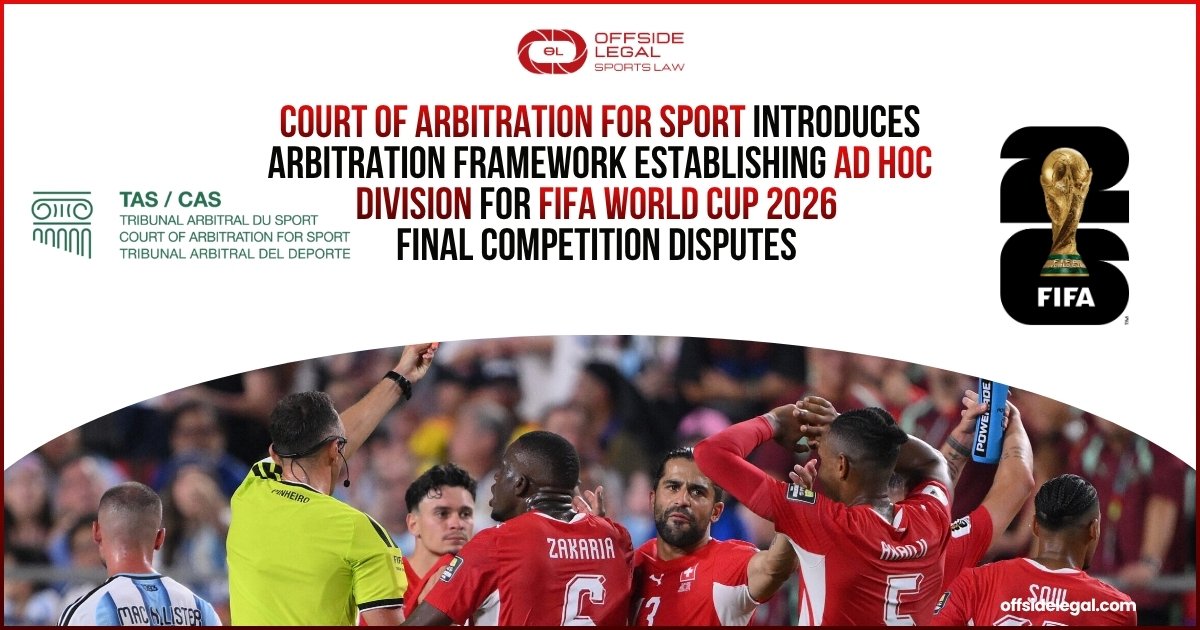
The Court of Arbitration for Sport has formally established a CAS ad hoc Division to resolve disputes arising during the FIFA World Cup 2026 final competition, running from June 11 to July 19, 2026. The Arbitration Rules for the FIFA World Cup 26 Final Competition, adopted by the ICAS Board on April 13, 2026, set out a fast, self-contained dispute resolution mechanism built specifically for the pressures of a month-long global tournament, where a delayed ruling can be as damaging as an unfavourable one. For sports law practitioners, the creation of this CAS ad hoc Division is a reminder that major tournaments now come with their own bespoke judicial infrastructure, built for speed rather than the slower rhythms of ordinary arbitration.
What the Ad Hoc Division Actually Is
Under Article 2 of the Rules, the International Council of Arbitration for Sport establishes the CAS ad hoc Division for the duration of the tournament, with the specific function of resolving disputes covered under Article 50 of the FIFA Statutes as they arise “during — and in connection with” the final competition. This is not a permanent CAS body; it is stood up specifically for the event and consists of arbitrators drawn from a special list, a President, a Deputy President, and a dedicated Court Office based in Lausanne, Switzerland. The special list, per Article 3, is limited to arbitrators who already sit on the CAS football list, meaning only those with recognised football-specific expertise can hear World Cup disputes, a deliberate narrowing designed to keep decision-making fast and specialised rather than generalist.
Jurisdiction: What Disputes Qualify
The CAS ad hoc Division does not have unlimited jurisdiction. Article 1 confines it to disputes covered by Article 50 of the FIFA Statutes that arise during and in connection with the tournament window itself. Article 11 adds a further condition: an application can only be filed once all internal legal remedies at FIFA have been exhausted, and it must be filed within the time limit set by Article 50. In practice, this means the ad hoc Division functions as a final, rapid-turnaround appeal mechanism once FIFA’s own internal processes, disciplinary committees, appeal committees and the like have run their course, rather than a first-instance forum for grievances.
Also read: IShowSpeed Incident Triggers FIFA Racism Investigation
Speed Is the Defining Feature
What sets this framework apart from CAS’s ordinary appeals procedure is the sheer compression of timelines. Article 19 requires the Panel to render a decision within 48 hours of an application being lodged, extendable only in exceptional circumstances by the President of the Division. Article 16(c) allows hearings to be convened on very short notice, typically by videoconference, and permits the Panel to skip a hearing altogether and issue an award immediately if it considers itself sufficiently informed. Article 15 further empowers the President or Panel to grant urgent preliminary relief — such as a stay of a challenged decision even without first hearing the opposing party, where the situation is one of extreme urgency. This is the practical logic behind the CAS ad hoc Division: a World Cup dispute over eligibility, a red card, or a disciplinary sanction cannot wait months for resolution the way a transfer dispute might.
Also watch: Webinar on Football Law ft. Mr. Deep Ray
Formation of the Panel and Procedural Safeguards
Once an application is filed, Article 12 gives the President of the ad hoc Division the power to appoint either a sole arbitrator or a three-member panel from the special list. Related disputes may be consolidated before the same panel where circumstances justify it. Articles 13 and 14 preserve core arbitral safeguards despite the compressed timeline; arbitrators must have legal training and recognised sports competence, must be independent of the parties, and are subject to challenge and removal if their independence is in doubt. Article 17 gives the Panel full power to establish the facts, and Article 18 specifies that disputes are decided under FIFA’s regulations and, additionally, Swiss law, consistent with CAS’s seat in Lausanne.
Finality and Costs
One of the more significant features of this CAS ad hoc Division is Article 22: decisions are enforceable immediately and cannot be appealed or otherwise challenged. This finality is what allows the World Cup to keep moving without a single dispute cascading into prolonged litigation, but it also means parties get exactly one fast shot at the process, with no further recourse. On costs, Article 23 provides that each party ordinarily bears its own legal representation costs, though appeals against FIFA disciplinary decisions are handled free of charge, with CAS itself absorbing the arbitrators’ fees and administrative costs in those cases. The Panel retains discretion to award a contribution toward the prevailing party’s legal fees, taking into account the complexity, outcome, and financial resources of the parties involved.
Also watch: International Transfers of Minors in Football | Mr. Lucio Mazzei
Why This Matters for Sports Law
For those of us tracking sports governance, the establishment of a CAS ad hoc Division for every major FIFA tournament reflects a broader trend: major sporting events increasingly need parallel, compressed-timeline judicial systems that operate independently of national courts and even of CAS’s own standard appellate track. Article 21 allows the Panel discretion to either issue a final award or refer a matter to the regular CAS Appeals or Ordinary Arbitration Division if the case is too complex or evidence-heavy to resolve within the tournament’s rapid timeline; a useful safety valve that keeps the ad hoc process from being forced into decisions it isn’t equipped to make well. This layered structure, blending emergency-speed justice with an escape valve to fuller proceedings, is likely to be the model for how CAS handles dispute resolution at future global tournaments as well.
As the FIFA World Cup 2026 progresses through its knockout stages, the CAS ad hoc Division stands ready to resolve any eligibility, disciplinary, or regulatory disputes that emerge, all under a 48-hour clock and with no right of appeal once decided. It is a compact but consequential piece of sports law infrastructure largely invisible when things run smoothly, but decisive the moment a dispute threatens to disrupt the tournament.
Read Here: ARBITRATION RULES FOR THE FIFA WORLD CUP 26 FINAL COMPETITION
This article is for informational purposes based on the published Arbitration Rules for the FIFA World Cup 26 Final Competition.