Introduction
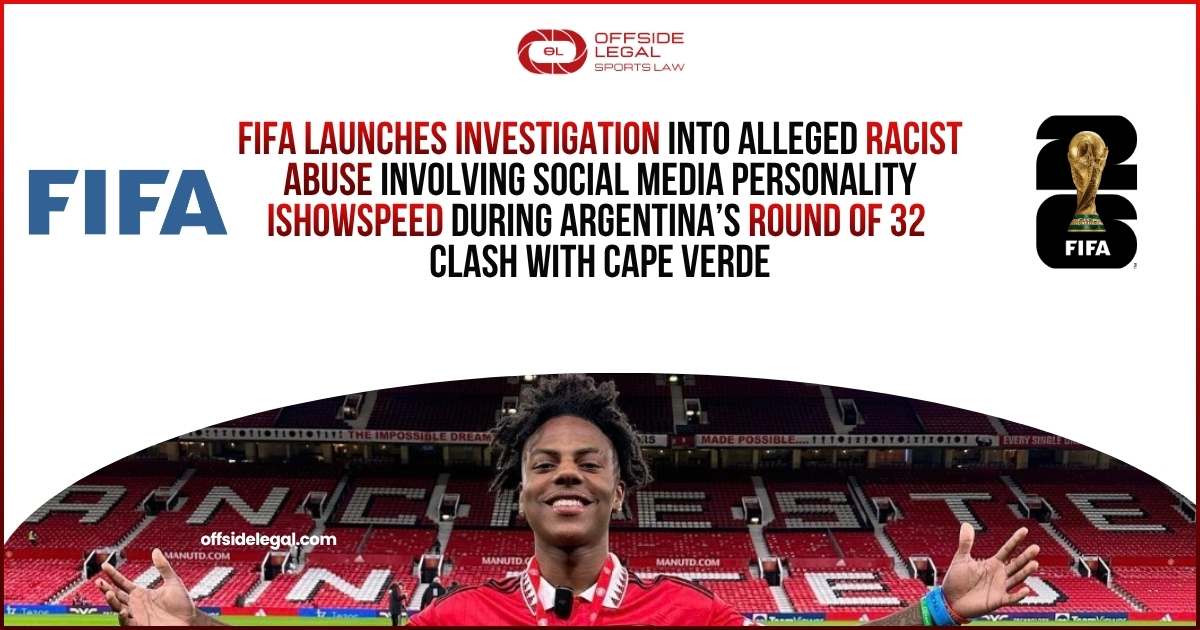
FIFA has opened a formal racism investigation after American streamer IShowSpeed, real name Darren Watkins Jr., was allegedly subjected to racist abuse from a supporter during Argentina’s Round of 32 clash with Cape Verde at World Cup 2026. The incident, which unfolded live on Speed’s own broadcast, has reignited a familiar and uncomfortable question for football’s governing body: how far can disciplinary law actually reach when discrimination happens in the stands rather than on the pitch. For a tournament built on the promise of unity and diversity, this FIFA racism investigation is more than a passing headline it is a live test of the enforcement machinery FIFA has spent years building.
What Happened at Hard Rock Stadium
The incident took place on July 3, 2026, at Hard Rock Stadium in Miami, during Argentina’s 3-2 extra-time win over Cape Verde. IShowSpeed, who has more than 57 million YouTube subscribers, was attending the match as part of a broadcast arrangement involving FIFA, YouTube and Fox Sports, and was wearing a Cape Verde jersey in support of the underdog side. During his livestream, a fan in an Argentina jersey leaned over the railing and directed comments at him in Spanish that were widely reported to include a racially charged remark telling him to “go cry at the zoo.” The exchange was captured in real time, on Speed’s own stream, viewed by millions before FIFA had even issued a statement — a detail that matters enormously for how this FIFA racism investigation will likely proceed.
Also read: Delhi High Court Quashes Yogasana Bharat’s NSF Recognition
FIFA’s Response
FIFA confirmed it was made aware of the incident and moved quickly, at least in terms of public messaging. Its statement read that the World Cup is “a celebration of unity, diversity and respect” and that “anyone who acts in a manner that undermines these values is not welcome in our game.” This is standard FIFA language, but the speed of the statement — issued within days of the match — signals that the governing body understands the reputational stakes of a viral, first-person account of alleged racism at its flagship tournament. It is worth noting this is not an isolated flashpoint for Argentina at this World Cup; separately, Kylian Mbappé faced abusive comments from a Paraguayan senator after eliminating Paraguay, drawing condemnation from FIFA’s Players’ Voice panel. Together, these episodes suggest the FIFA racism investigation into the IShowSpeed incident sits within a broader pattern the organisation is under pressure to address consistently.
The Legal Framework Governing the Probe
From a sports law standpoint, the relevant instrument is FIFA’s Disciplinary Code, which contains specific provisions on discrimination separate from ordinary spectator misconduct. Racist or discriminatory conduct by supporters can trigger sanctions against the offending individual where identifiable, and in more serious or repeated cases, against the member association whose fans are involved, on the theory that associations bear a strict liability duty to ensure order and non-discriminatory conduct among their supporters at matches. This is precisely why a FIFA racism investigation of this kind is never purely about one fan’s comment, it inevitably raises the question of whether the Argentine Football Association could face consequences of its own, ranging from a formal warning to a fine, partial stadium closure for future fixtures, or points deductions in more extreme historical cases, though the latter is rare and reserved for gross or repeated violations.
Also watch: Webinar on Football Law ft. Mr. Deep Ray
Evidentiary Challenges: Proving the Case
One of the more interesting legal dimensions here is evidentiary. Unlike pitch-side racist chanting captured by broadcast cameras and match officials’ reports, this incident exists primarily as user-generated livestream footage. FIFA’s investigators will need to authenticate the clip, identify the individual involved, and assess whether the language used meets the threshold for discriminatory conduct under the Disciplinary Code, rather than being dismissed as generic abuse. This is where a FIFA racism investigation of this nature differs meaningfully from conventional cases: the primary evidence originates from a content creator’s monetised stream, not from an accredited broadcaster or a match commissioner’s report, which raises interesting procedural questions about admissibility and chain of custody in what is, in effect, a quasi-judicial disciplinary process.
Why This Matters Beyond Football
For those of us who follow sports governance closely, this FIFA racism investigation is a useful case study in the gap between institutional statements and institutional teeth. FIFA has strengthened its anti-discrimination language significantly since 2022, including the introduction of a three-step protocol allowing referees to stop or abandon matches over discriminatory chanting. But that protocol was designed for organised, audible stadium-wide chanting, not an individual exchange between a fan and a content creator. This incident therefore tests whether FIFA’s disciplinary architecture can adapt to a world where supporters, streamers, and social media users are increasingly the ones generating the evidence that regulators must act on. It is a live illustration of how sports law is being reshaped not just by what happens on the field, but by what gets recorded, live-streamed, and litigated in the court of public opinion long before any formal hearing begins.
What Comes Next
FIFA has not indicated a timeline for concluding the investigation, and past cases suggest outcomes can range from a private reprimand to a stadium ban for the individual fan, with association-level sanctions reserved for clearer patterns of misconduct. What is certain is that this FIFA racism investigation will be watched closely, both as a test of FIFA’s post-2022 disciplinary reforms and as a signal of how seriously the governing body treats discrimination directed at public figures attending its tournaments in a personal capacity rather than as players or officials. For sports law observers, the case is a reminder that discrimination disputes in football are no longer confined to the pitch, and governance frameworks will need to keep pace with where the abuse and the evidence of it actually happens.
Also watch: Freedom of Speech in Sports | Mr. Tarun
This article is for informational purposes and reflects publicly available reporting on an ongoing matter. Offside Legal will continue tracking developments in this FIFA racism investigation as they emerge.