Introduction
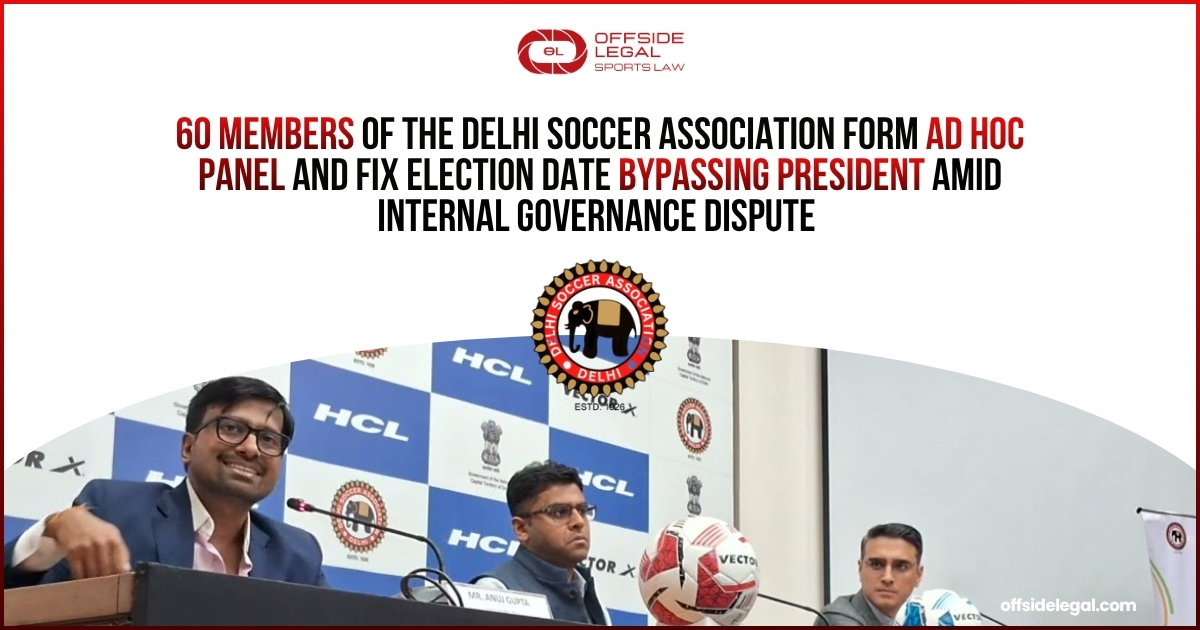
Sixty members of the Delhi Soccer Association have come together to form an ad hoc panel and fix an election date, effectively bypassing the sitting president amid a deepening internal governance dispute. The move marks a significant escalation in what appears to be a contest over control of the state football body, and it raises pointed questions about the legal validity of member-led interventions when a federation’s leadership is seen as unresponsive or obstructive. For an organisation entrusted with running the sport at the state level, this standoff within the Delhi Soccer Association is likely to draw scrutiny from the All India Football Federation and, potentially, the courts.
What Triggered the Delhi Soccer Association Dispute
Disputes of this nature typically arise when a section of a federation’s membership believes that elections are being delayed, governance norms are not being followed, or the incumbent leadership is acting beyond its mandate. In the case of the Delhi Soccer Association, sixty members reportedly decided that the sitting president was not taking the necessary steps to conduct timely elections, prompting them to convene independently, constitute an ad hoc panel, and announce an election date on their own. This is an unusual but not unprecedented step in Indian sports administration, where similar governance breakdowns have played out in federations governing wrestling, boxing, and table tennis in recent years.
Also Read: Delhi High Court Quashes Yogasana Bharat’s NSF Recognition
The Legal Question: Can Members Bypass the President?
The central legal issue here is whether a group of members within the Delhi Soccer Association has the authority to bypass the president and unilaterally form an ad hoc panel to conduct elections. Under most sports federation constitutions, and under the framework set out by the National Sports Governance Act, 2025, the power to convene elections, constitute committees, or amend the governance calendar typically vests in the elected office-bearers or the general body acting through a properly constituted meeting — not in an ad hoc grouping of members acting outside formal channels.
That said, courts in India have, in specific circumstances, recognised that when an incumbent president or executive committee is deliberately stalling elections beyond their mandated term, members retain limited recourse — including approaching the sports ministry, the National Sports Federation regulatory framework, or the courts themselves to seek directions for time-bound elections. Whether the ad hoc panel formed by these sixty members will hold up depends heavily on:
- Whether the Delhi Soccer Association’s own constitution or bye-laws permit member-driven intervention in circumstances of prolonged electoral delay.
- Whether proper notice and quorum requirements were followed when the members convened to form the ad hoc panel.
- Whether the All India Football Federation or the Sports Ministry has already been approached or has taken cognisance of the internal dispute, since state associations typically operate under the affiliation and oversight of their national federation.
- Whether the incumbent president had, in fact, exceeded any permissible tenure or election timeline, which would strengthen the members’ position considerably.
Also Read: AIFF Sportspersons of Outstanding Merit: Retired Players Invited
The Bigger Picture for Indian Sports Governance
The unfolding situation at the Delhi Soccer Association is a useful window into a broader governance problem that has plagued Indian sports administration for years: prolonged tenures, delayed elections, and internal factionalism that often only gets resolved through litigation or ministry intervention. The National Sports Governance Act, 2025 was specifically designed to bring greater structure to these processes, including mandated election timelines and dispute resolution mechanisms for National Sports Federations and their affiliated state units.
If the Delhi Soccer Association’s ad hoc panel proceeds with elections as scheduled, and the sitting president challenges this move, the matter could well end up before the Delhi High Court or a sports tribunal constituted under the new governance framework. Such disputes often hinge on procedural technicalities — whether meetings were validly convened, whether adequate notice was given, and whether the ad hoc panel’s composition itself meets constitutional requirements — rather than purely on the merits of who should ultimately lead the association.
For now, the Delhi Soccer Association finds itself in a state of institutional limbo, with two competing claims to legitimacy: the sitting president’s continued authority on one hand, and the ad hoc panel’s member-backed mandate on the other. Much will depend on how the All India Football Federation responds, since state associations derive their recognition from their national federation and are expected to resolve internal disputes in line with both their own constitutions and the overarching governance framework. Should the dispute escalate, it would not be the first time a state-level football body in India has had its internal politics spill over into formal legal proceedings.
For stakeholders following Indian sports law, the Delhi Soccer Association situation offers a live case study in how governance vacuums are contested, and whether member-led ad hoc interventions can survive legal scrutiny when tested against a federation’s own constitutional framework and the National Sports Governance Act, 2025.
Also watch: International Transfers of Minors in Football | Mr. Lucio Mazzei
This article is for informational purposes and reflects publicly available reporting on an ongoing matter.