Introduction
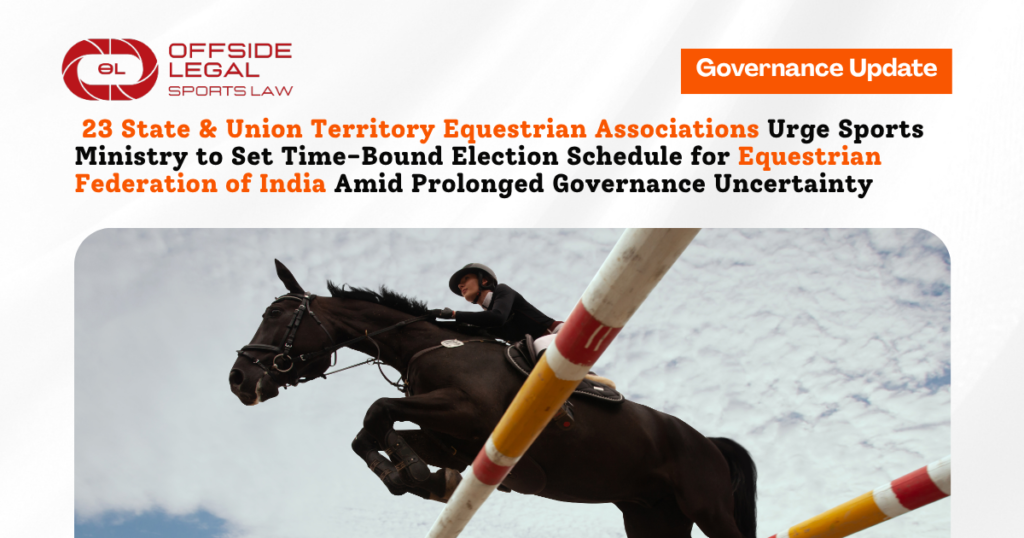
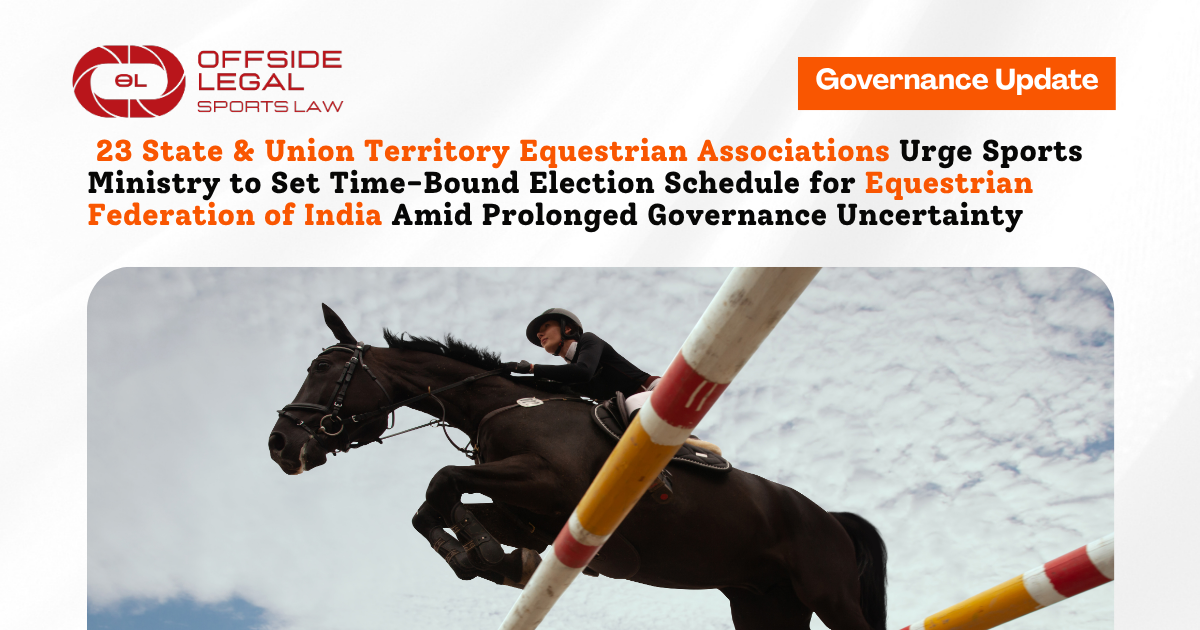
Twenty-three State and Union Territory Equestrian Associations have written to the Union Sports Ministry demanding a strict, time-bound EFI election schedule for the Equestrian Federation of India, as governance uncertainty at the national body continues to drag on. The associations argue that prolonged delays in holding fresh elections have left the federation without a stable, accountable leadership structure, and that a clear timeline is now essential to restore normal functioning ahead of the sport’s upcoming domestic and international calendar.
Background: A Federation Under Prolonged Scrutiny
The Equestrian Federation of India has been embroiled in governance disputes for over a decade, much of it playing out before the Delhi High Court. State Associations, led prominently by bodies such as the Rajasthan Equestrian Association, have repeatedly challenged the composition of EFI’s electoral college, arguing that the inclusion of clubs and institutional members alongside State and Union Territory Associations was contrary to the National Sports Development Code of India.
The Code also envisages a pyramidal structure with voting rights vested primarily in State units. The Delhi High Court has, on multiple occasions, including in a ruling upheld by a Division Bench, affirmed that clubs affiliated with EFI do not carry independent voting rights, reinforcing the primacy of State Associations in the federation’s internal democracy.
Against this backdrop, the Court had also earlier directed the constitution of a fact-finding committee to examine EFI’s affairs, with elections for a new executive contingent on the committee’s report being finalised. That process has stretched on for an extended period, leaving the federation to function under interim or ad-hoc arrangements rather than a democratically elected leadership. It is in this context that the demand for a defined EFI election schedule has now gathered fresh momentum among the State units.
Also watch: National Sports Governance Act, 2025 ft. Mr. Vidushpat Singhania
What the State Associations Are Seeking
According to the representation made to the Ministry, the 23 signatory associations have urged the government to fix concrete outer timelines for the pending EFI elections, rather than allowing the process to remain open-ended. Their core contention is that the absence of a settled EFI election schedule has practical consequences well beyond internal politics: it affects athlete selection processes, coaching and training continuity, participation in international qualifying events, and the federation’s ability to plan a coherent annual calendar. State bodies have also flagged that prolonged administrative uncertainty makes it difficult for riders and their state federations to plan training cycles with any confidence.
The associations have reportedly asked the Ministry to set a definitive window within which the elections must be concluded once the relevant judicial and procedural steps are completed, rather than leaving the timeline to be determined informally. This mirrors similar interventions the Ministry has made in the past with other national federations, where clauses found to be restrictive or non-compliant with the Sports Code were flagged and federations were given a fixed period, often around three months, to hold fresh elections.
Governance Implications for Indian Sports Federations
The push for a firm EFI election schedule reflects a broader governance concern that recurs across Indian sports administration: the tension between judicial oversight, ministerial intervention, and a federation’s internal autonomy. Under the Sports Code framework, and now increasingly under the newer National Sports Governance Act, 2025, national federations are expected to maintain electoral colleges that are compliant, transparent, and reflective of State-level representation. When elections are delayed indefinitely, whether due to litigation, non-compliance findings, or internal disputes, it is typically the State Associations and, by extension, the athletes they represent, who bear the practical cost.
For EFI specifically, the demand for a clear EFI election schedule also intersects with earlier findings that its electoral college was skewed in favour of clubs over State Associations, a structural issue the courts have already flagged as inconsistent with the Code. A firm timeline, if accepted by the Ministry, would not only address the immediate governance vacuum but could also serve as a template for how other federations facing similar transitional uncertainty are handled going forward.
Also watch: Webinar on What is Doping in Sports Ft. Mr. Parth Goswami
What Comes Next
The Sports Ministry is now expected to examine the representation from the 23 State and Union Territory bodies and respond on whether it will direct EFI toward a fixed EFI election schedule. Given the federation’s long history of litigation and repeated adverse findings on its electoral structure, any Ministry directive is likely to be closely watched, both by the State Associations pressing for resolution and by the broader sports governance community tracking how the newer statutory framework under the National Sports Governance Act is applied in practice.
Also read: Viswanathan Anand FIDE President After 21st EU Sanctions Package