Introduction
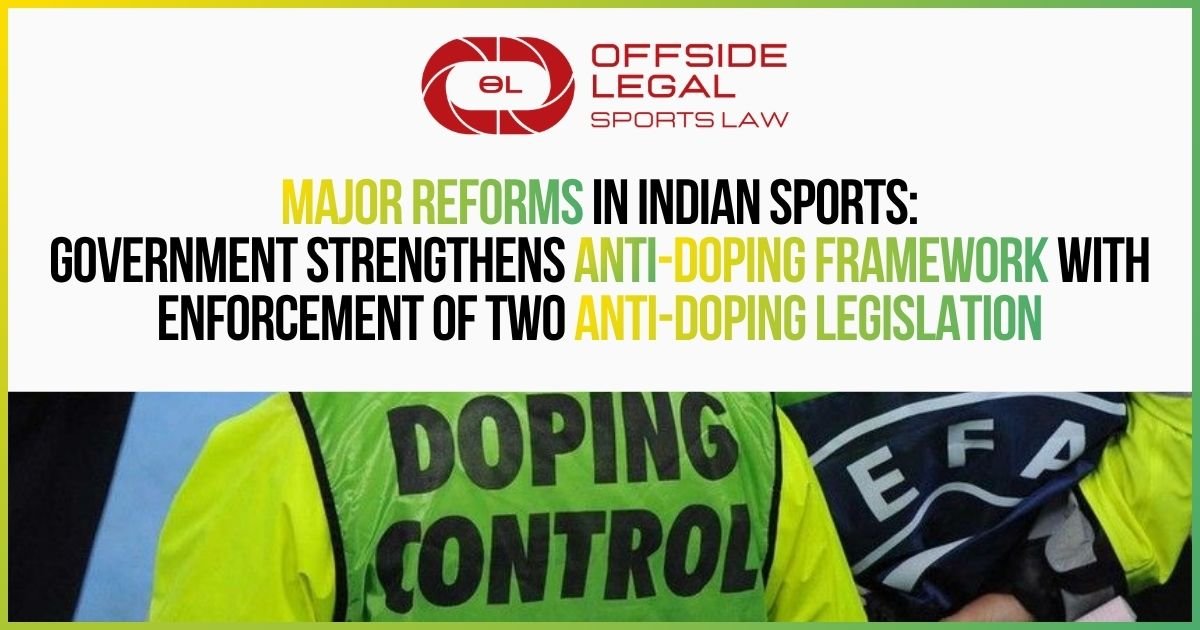
The National Anti-Doping (Amendment) Act, 2025 has brought sweeping changes to India’s anti-doping regulatory landscape. Notified as No. 26 of 2025, this amendment reshapes the National Anti-Doping Act, 2022 to bring India’s domestic law in closer alignment with the World Anti-Doping Code (the “Code”). Notably, the National Anti-Doping Act, 2022 itself was brought into force only on 15th July 2026, and the National Anti-Doping (Amendment) Act, 2025 followed immediately after, taking effect on 16th July 2026. Below are the key changes it has introduced, provision by provision.
Why the National Anti-Doping (Amendment) Act, 2025 Was Needed
The National Anti-Doping Act, 2022 gave statutory backing to anti-doping efforts and established the National Anti-Doping Agency (NADA) as India’s principal testing and enforcement body. Gaps remained, however, between the domestic framework and the evolving text of the WADA Code, particularly around definitions, results management, and the appeal process. The National Anti-Doping (Amendment) Act, 2025 closes these gaps by directly incorporating relevant provisions of the Code into a new Schedule, giving them binding force of law in India.
Also watch: National Sports Governance Act, 2025 ft. Mr. Vidushpat Singhania
Key Changes Under the Amendment
A New Definition of “Anti-Doping Organisation”
The amendment inserts a new clause (aa) into Section 2, defining “Anti-Doping Organisation” to include WADA itself, signatories to the Code, the International Olympic Committee, the International Paralympic Committee, International Federations, and National Anti-Doping Organisations. This clarifies the ecosystem of bodies whose rules and decisions now interact with India’s domestic framework.
Direct Legal Force for the World Anti-Doping Code
The most consequential feature of the amendment is new Section 2A, which states that the provisions of the Code set out in the newly added Schedule “shall have the force of law in India,” notwithstanding anything to the contrary in any other law. The Schedule reproduces Article 2 of the Code in full, covering all eleven categories of anti-doping rule violations, from presence of a prohibited substance to prohibited association and retaliation against whistleblowers. The Central Government retains the power to update the Schedule by gazette notification as the Code evolves, subject to each notification being laid before Parliament.
Expanded and Restructured Anti-Doping Rule Violations
Section 4 of the principal Act has been entirely substituted. The new provision restructures the categories of Anti-Doping Rule Violation (ADRV) and, notably, extends the prohibited association clause and the whistleblower-retaliation clause into the statutory text itself, mirroring Articles 2.10 and 2.11 of the Code. This means conduct such as knowingly associating with a coach or support person serving a period of ineligibility, or retaliating against someone who reports a violation in good faith, is now explicitly recognised as an ADRV under Indian law.
Governance and Procedural Updates
Section 12 replaces references to the “Board” with “Central Government,” and matters earlier “specified by regulations” are now “prescribed” by rules — centralising certain powers previously exercised through the Board’s regulatory framework. Separately, Section 19 now refers to the Bharatiya Nagarik Suraksha Sanhita, 2023 instead of the erstwhile Code of Criminal Procedure, 1973, aligning the Act with India’s wider criminal law reforms.
Also Read: Sports Law Bootcamp 2026: Registrations Open
Streamlined Testing and Results Management
Sections 20 and 21 have been substituted to streamline the process by which NADA orders sample collection and manages adverse analytical findings. The amended Section 21 introduces a clearer framework for the Agency’s initial examination of adverse reports, including verification of Therapeutic Use Exemptions and possible departures from International Standards for Laboratories or Testing and Investigations.
A Broader Appeal Mechanism to the Court of Arbitration for Sport
Section 23 has been substantially reworked. The amendment expands the list of parties who may appeal decisions to the Court of Arbitration for Sport (CAS) in cases involving international-level athletes or events, adding the International Olympic Committee and International Paralympic Committee where Olympic or Paralympic eligibility is affected. It also grants WADA a standalone right of appeal under Article 13 of the Code, without needing to exhaust other domestic remedies first, where no other party has appealed a final decision.
Institutional Independence for the Director General
A new sub-section (7) has been added to Section 14, guaranteeing that the Director General and staff of the Agency operate with independence from National Sports Federations, International Federations, the National Olympic Committee, the National Paralympic Committee, and any government department connected with sport. This addresses long-standing concerns around institutional conflicts of interest in Indian anti-doping enforcement.
Other Notable Amendments
The amendment also makes several smaller changes across the principal Act. Section 6 now applies consequences of Anti-Doping Rule Violations to “athlete or other person,” widening the earlier, narrower “individual athlete or athlete support personnel” formulation. Section 7 adds the National Olympic Committee and National Paralympic Committee to the list of bodies with which Board members are barred from taking up post-tenure employment. Section 17 replaces “Therapeutic Exemption” with “Therapeutic Use Exemption” to match the Code’s terminology. Section 26 makes WADA accreditation of dope testing laboratories mandatory rather than optional, and ties laboratory procedures to the International Standard for Laboratories. Section 29’s rule-making powers are expanded to cover the Appeal Panel’s constitution and the Section 23 appeal procedure, while several clauses under Sections 30 and 31 that duplicated matters now covered elsewhere have been omitted.
Also watch: Player Contracts in Sports ft Mr. Siddharth Nayak
What This Means for Athletes, Federations, and Legal Practitioners
Under the National Anti-Doping (Amendment) Act, 2025, the Code’s provisions on strict liability, whereabouts failures, prohibited association, and retaliation are no longer merely persuasive international guidance, they are directly enforceable Indian law under Section 2A and the Schedule. Athlete support personnel, coaches, and federations are now subject to the prohibited association clause, and the expanded Section 23 appellate framework brings a wider set of parties, including WADA, the IOC, and the IPC, into the appeal process before the Court of Arbitration for Sport.
In summary, the National Anti-Doping (Amendment) Act, 2025 brings the National Anti-Doping Act, 2022 substantially closer to the text and structure of the World Anti-Doping Code, through direct incorporation of Code provisions via the Schedule, restructured Anti-Doping Rule Violations, an expanded CAS appeal mechanism, and an institutional independence guarantee for the Director General and Agency staff.