Introduction
In a significant development within the domain of sports jurisprudence, the present Doping Appeal adjudicated by the Anti-Doping Appeal Panel has brought into sharp focus the extent of liability that may be attributed to support personnel, particularly coaches, under the anti-doping regulatory framework. The case concerning Coach Ramesh Nagapuri raises critical questions pertaining to allegations of complicity, procedural safeguards, and the evidentiary threshold required to sustain disciplinary measures under anti-doping laws.
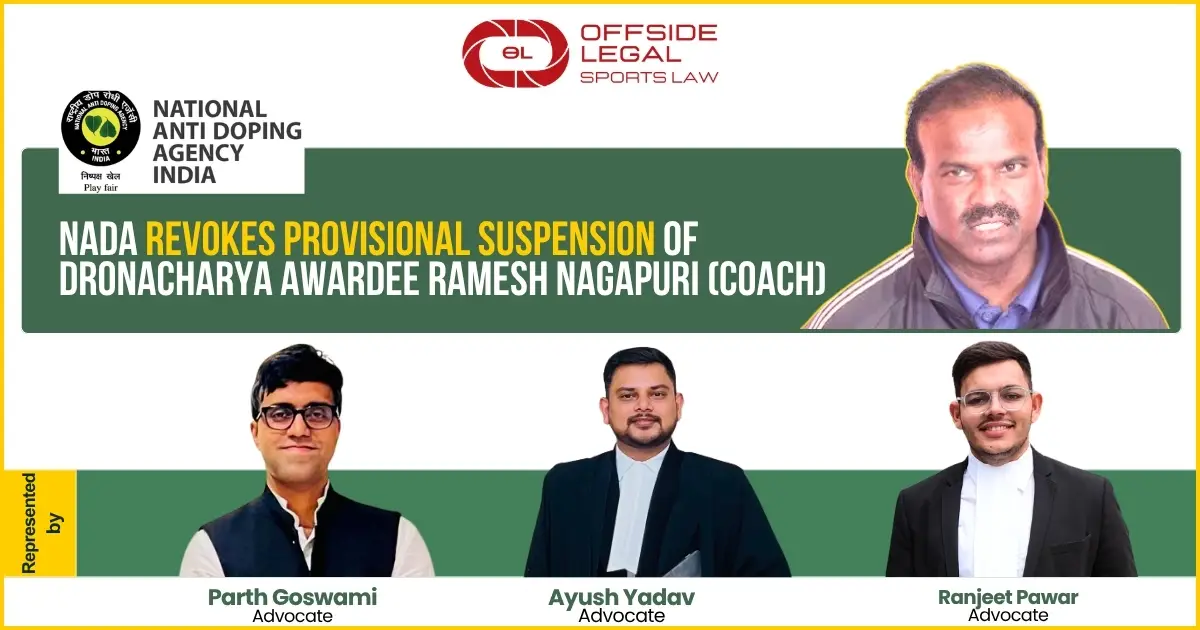
The Doping Appeal arises out of an order dated 03.07.2025 passed by the Anti-Doping Disciplinary Panel (ADDP), whereby the application filed by the Appellant seeking revocation of his provisional suspension was dismissed. Aggrieved by the said order, the Appellant preferred the present appeal seeking setting aside of the impugned decision and restoration of his rights pending adjudication.
Factual Background
The genesis of the present Doping Appeal can be traced to events dated 02.12.2024, when officials of the National Anti-Doping Agency conducted a doping control exercise at the G.M.C. Balayogi Athletics Stadium, Hyderabad. During the notification process, it was alleged that the Appellant, acting in his capacity as a coach, interfered by preventing athletes from signing the requisite notification forms.
It was further alleged that the Appellant instructed the athletes to leave the venue, thereby facilitating evasion from the doping control process. Additionally, the Appellant was accused of failing to provide contact details of the athletes under his supervision, which was interpreted as an attempt to obstruct the process.
Based on these allegations, proceedings were initiated under the National Anti-Doping Rules, 2021, particularly invoking Article 2.9 relating to complicity. Consequently, a provisional suspension was imposed on 17.03.2025 pending the outcome of disciplinary proceedings.
Submissions on Behalf of the Parties
In the course of the Doping Appeal, the Appellant denied all allegations and challenged the legality and proportionality of the provisional suspension. It was contended that the allegations lacked substantive evidentiary support and failed to establish intentional assistance or complicity in doping evasion.
The Appellant further argued that procedural safeguards under the anti-doping framework were not properly followed, thereby rendering the suspension arbitrary. Emphasis was placed on the necessity of proving intent in cases involving allegations of complicity.
Conversely, the Respondent submitted that the conduct of the Appellant amounted to clear interference in the doping control process. Preventing athletes from complying with notification requirements and directing them away from the venue, it was argued, constituted active assistance in evasion under the applicable rules.
Also apply: Webinar on Football Law with Mr. Deep Ray
Observations and Findings of the Panel
The Doping Appeal witnessed a divergence of opinion within the Panel, with a minority view suggesting that a prima facie violation existed. However, the majority undertook a comprehensive evaluation of the material on record, including pleadings, evidence, and submissions advanced by both parties.
The Panel emphasized that findings of complicity must be supported by clear and convincing evidence demonstrating intentional participation. Mere suspicion or indirect involvement was held to be insufficient to sustain a violation.
While certain aspects of the Appellant’s conduct raised concerns, the Panel found that the evidentiary record did not conclusively establish intentional assistance in evasion of doping control.
Decision in the Doping Appeal
In light of the analysis, the Panel held that the continuation of the provisional suspension was not justified. Accordingly, relief was granted in the Doping Appeal, and the suspension imposed upon Coach Ramesh Nagapuri was set aside.
The decision underscores the necessity of adhering to principles of natural justice and ensuring that disciplinary measures are based on robust and reliable evidence.
The outcome of the present Doping Appeal holds considerable significance in the evolving landscape of sports law in India. It clarifies the contours of liability of coaches within the anti-doping regime and reinforces that liability cannot be presumed in the absence of demonstrable intent.
The ruling also highlights the importance of balancing strict enforcement of anti-doping regulations with procedural fairness and due process. It contributes to the broader jurisprudence by emphasizing that evidentiary rigour remains central to the adjudication of such disputes.
In conclusion, this Doping Appeal serves as an important precedent, reaffirming that fairness, proportionality, and due process are indispensable to maintaining integrity in sports adjudication.
Also watch the webinar “Understanding Doping in Sports: From Sample to Sanction – What Really Happens Behind the Scenes” by Adv. Parth Goswami for a comprehensive insight into anti-doping law and practice.